
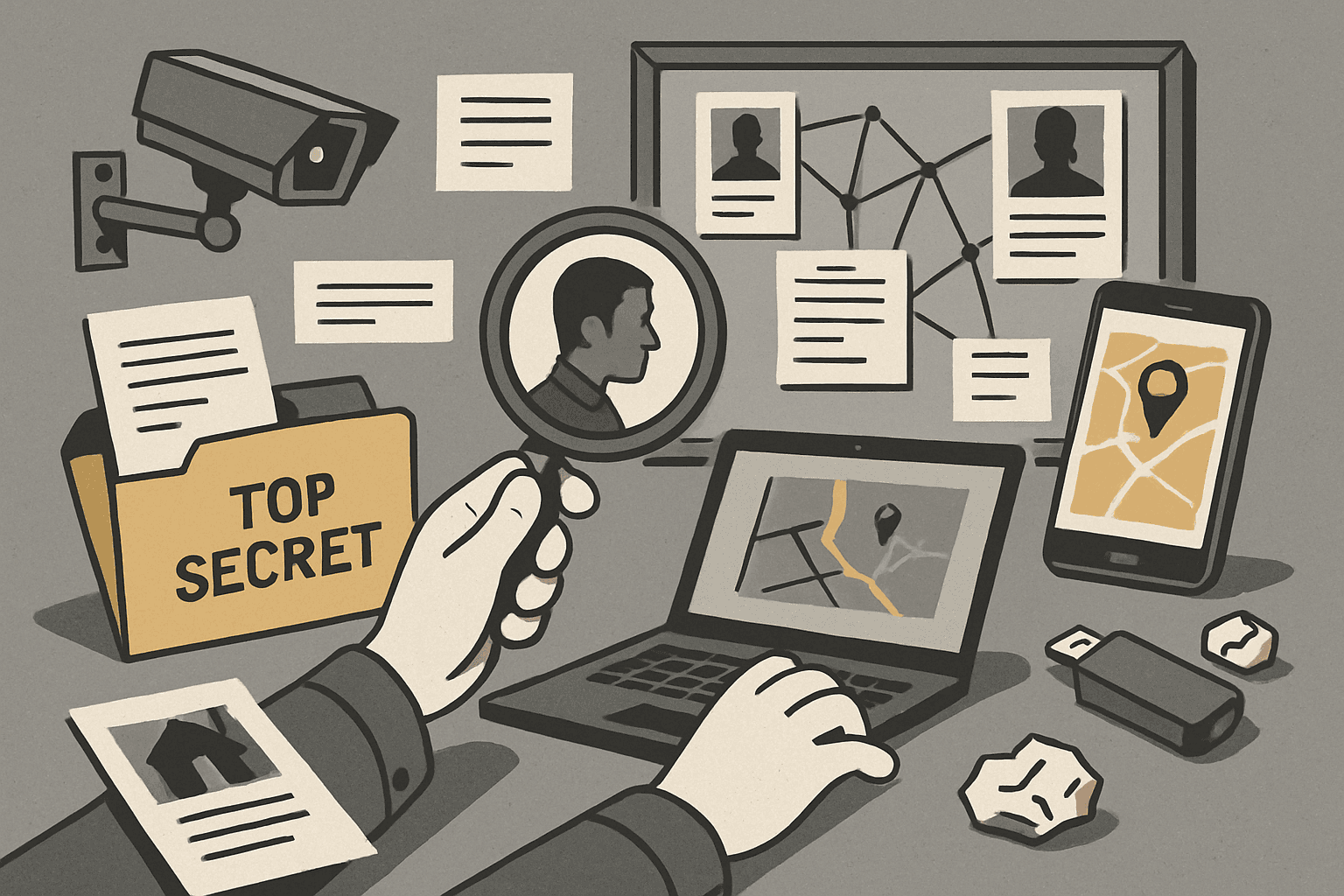
OSINT Explained: Methods, Tools, and Investigative Frameworks for Legal Professionals
Learn defensible open-source intelligence methods, core tools, and structured investigative frameworks built for Canadian legal professionals and security teams.
Open-source intelligence (OSINT) is the discipline of collecting, processing, and analysing information drawn exclusively from publicly available sources to produce finished, actionable intelligence. For legal professionals, that definition carries procedural weight: a defensible OSINT investigation requires structured methodology, rigorous documentation, and strict compliance with Canadian privacy law from the first query to the final report.
Defining Open-Source Intelligence in a Modern Context
Open-source intelligence has roots in wartime press monitoring. The U.S. Foreign Broadcast Information Service was established in 1941 to systematically collect publicly available radio transmissions. Eight decades later, the discipline has expanded to encompass billions of indexed web pages, satellite imagery, social media posts, and public court records, making it indispensable to modern legal and security work.
What exactly is OSINT and how does it differ from other intelligence disciplines?
OSINT is intelligence derived exclusively from publicly available sources rather than from clandestine collection. The broader intelligence community recognises six disciplines: OSINT, HUMINT (human sources), SIGINT (intercepted signals), IMINT (imagery), MASINT (measurement and signatures), and GEOINT. The "open" in OSINT refers to source availability, not to the classification level of the finished product. For a detailed comparison, see open-source intelligence vs traditional investigation. The U.S. government definition of OSINT from CISA confirms that the discipline is grounded in publicly producible, lawfully accessible information.
The publicly available data universe: scope, sources, and legal boundaries in Canada
Source categories within the OSINT universe include the open web, social media platforms, academic publications, commercial satellite imagery, government databases, and public court records. Canada's Privacy Act (1985) and the Personal Information Protection and Electronic Documents Act establish that "publicly available" carries a specific legal meaning distinct from "technically accessible." A platform's privacy policy may make content visible yet still restrict its systematic collection. Scraping in violation of platform terms can compromise the evidentiary value of gathered data and expose counsel to adverse arguments at trial.
How intelligence agencies, law firms, and security teams apply OSINT differently
Three distinct professional contexts shape how OSINT is deployed:
- National security and law enforcement: Threat actor attribution, organised-crime network mapping, and counter-terrorism. Canadian law enforcement agencies including the RCMP use OSINT in organised-crime investigations alongside traditional enforcement methods.
- Law firms: Due diligence on counterparties, litigation support, and asset tracing. See OSINT for corporate fraud investigations for applied techniques.
- Corporate security: Vendor risk assessment, attack-surface monitoring, and third-party organisation screening. Outputs feed directly into security management decisions.
The OSINT Framework: A Structured Methodology for Collecting and Analyzing Intelligence
Think of an osint framework the way a litigator thinks of disclosure rules: without a defined process governing what is collected, how it is preserved, and how it is presented, even the most compelling data point loses its persuasive weight. A structured methodology transforms raw public data into analysis that can withstand scrutiny in court or a boardroom.
The five-phase intelligence cycle applied to open-source data: collection, processing, analysis, dissemination, and action
The intelligence cycle has been the procedural backbone of allied intelligence communities since at least the 1950s. ENISA's framework guidance identifies structured methodology as a critical success factor in professional OSINT programs. The five phases, applied to a legal-investigative context, are as follows:
| Phase | Description | Legal-Practitioner Consideration |
|---|---|---|
| 1. Collection | Gathering raw data from publicly available sources | Define permissible source categories in advance; log every query |
| 2. Processing | Converting raw data into usable formats | Verify authenticity; timestamp and preserve original files |
| 3. Analysis | Interpreting processed data against the intelligence requirement | Apply structured analytic techniques; document reasoning chain |
| 4. Dissemination | Delivering the finished intelligence product to the client or counsel | Confirm privilege protection before distribution |
| 5. Action | Decisions or legal steps taken on the basis of finished intelligence | Document the link between analysis and consequent action |
All 5 phases must be completed and documented; partial cycle completion is a common grounds for challenging digital evidence in Canadian proceedings.
How does the OSINT framework organize investigative workflows?
A well-implemented framework creates audit-trail discipline. Every collection step is logged against a specific intelligence requirement document, which acts as a tasking instrument defining the question the investigation must answer. This process reduces both duplication of effort and coverage gaps. Practitioners applying lawful OSINT techniques for litigation find that structured workflow organisation is the single most effective way to defend the integrity of gathered data before a court.
Adapting the framework for legal and compliance-constrained environments
OSINT reports commissioned by counsel may attract solicitor-client privilege in Canada, provided the dominant purpose of the engagement is litigation preparation. Automated collection tools must be configured to respect robots.txt directives and platform terms of service. PIPEDA compliance requires that collection of specific personal data be proportionate to the stated investigative purpose. Sound data management practices, including access controls and retention schedules, reduce the organisation's exposure to regulatory scrutiny and protect the integrity of the overall process.
Common methodology pitfalls that compromise the evidentiary value of gathered intelligence
The following pitfalls are regularly cited when digital evidence is challenged:
- Failure to timestamp screenshots at the moment of collection, making currency of the publicly available data impossible to confirm
- Chain-of-custody gaps in data export, particularly when analysis software transforms source files
- Confirmation bias in source selection, where intelligence that contradicts the working hypothesis is de-prioritised
- Reliance on a single unverified source without corroboration from independent data streams
- Conflating correlation with attribution, a logical error that courts have found fatal to digital evidence arguments
- Omitting a source reliability grade, leaving the analysis vulnerable to attack on provenance grounds
Canadian courts apply authentication requirements to digital exhibits; unsupported evidence routinely fails that threshold.
Core OSINT Tools and Their Practical Applications
According to industry surveys, security and investigation teams regularly draw on more than 50 distinct open-source data sources in a single investigation. The proliferation of tools, spanning search engine operators, social media scrapers, WHOIS lookups, and identity-resolution platforms, means practitioners must evaluate each tool against reliability, legal permissibility, and reproducibility before incorporating it into a professional workflow.
Search engine operators and advanced query techniques for surfacing publicly accessible records
Advanced search engine operators allow investigators to scope queries to specific domains, file types, and URL patterns. Google and Bing both support operators including site:, filetype:, inurl:, and intitle:, and Google alone supports more than 40 documented operator variations. Boolean combinations with domain scoping can surface publicly accessible court filings, corporate documents, and cached data not easily found through standard keyword search. Operator syntax differs slightly between engines, so query sets should be reproduced across both platforms to ensure full coverage of the public data universe.
Social media intelligence: extracting structured data from open profiles and public posts
Public social media data posted without access restrictions is lawfully collectible; private data behind authentication barriers is not accessible without authorisation. Platforms including LinkedIn, Facebook, X (formerly Twitter), and Instagram embed metadata in public posts, such as timestamps, geotags, and device identifiers, that carry analytical value beyond the visible content. Network mapping across public connections can reveal undisclosed relationships relevant to litigation. Platform API access has narrowed considerably since 2018, which has shifted professional practice toward manual collection and purpose-built tools. For cross-language collection considerations, see multilingual OSINT research for legal investigators.
Public records aggregators, WHOIS databases, and corporate registry lookups
Canadian-specific public record sources include Corporations Canada, provincial land title registries, court electronic filing systems accessible through CanLII, and federal insolvency records maintained by the Office of the Superintendent of Bankruptcy. WHOIS databases historically provided registrant contact data for domain names; GDPR-driven redaction in 2018 significantly reduced availability of registrant data for domains registered outside Canada. OpenCorporates aggregates corporate registry data from more than 140 jurisdictions, making it a valuable source for cross-border due diligence. For applied guidance on integrating these sources, see OSINT for due diligence at Canadian law firms.
Email address and digital identity verification tools used by investigators
Hunter.io resolves email address formats associated with specific domains, supporting identity verification in business-intelligence contexts. Have I Been Pwned returns publicly disclosed breach-exposure data for a given email address without involving any private interception of communications. Shodan functions as an internet-wide scan index rather than an active probe; it indexes over 3 billion internet-connected devices, making it a primary tool for infrastructure correlation and attack surface research. All three tools return only data that is already in the public or disclosed domain, which preserves the lawful character of the collection.
Which OSINT tools are considered most reliable for professional investigations?
Three evaluation criteria apply in a Canadian legal context:
- Data provenance transparency: Maltego, Recon-ng, and SpiderFoot each allow the investigator to trace a data point back to its originating source, which is essential for authentication
- Legal permissibility: Tools must not circumvent access controls or violate platform terms in a manner that could render evidence inadmissible or expose counsel to liability
- Reproducibility: A court-ready investigation requires that another qualified analyst could re-run the same queries and obtain consistent results
No single tool covers the full data universe; professional investigations require layered tool use across multiple categories. The current professional OSINT tool landscape is detailed in Recorded Future's threat intelligence resource library.
Recommended tool categories with representative examples:
- Search operators: Google / Bing advanced search
- Social media intelligence: Maltego
- WHOIS / domain lookup: DomainTools
- Corporate registry: OpenCorporates
- Email verification: Hunter.io
- Geolocation: GeoHack
Conducting a Defensible OSINT Investigation Step by Step
The majority of OSINT investigation failures are procedural, not technical. Practitioners who skip the scoping phase, omit chain-of-custody documentation, or conflate correlation with attribution do not fail because they lacked access to data. They fail because the process did not survive adversarial scrutiny. A defensible investigation is built step by step before a single query is executed.
Defining the intelligence requirement and scoping the target before data collection begins
The intelligence requirement (IR) document defines the specific question the investigation must answer before any gathering begins. Scope elements include subject identity, geographic boundaries, time horizon, and permissible source categories. A poorly scoped IR leads to over-collection, which creates privacy-compliance exposure and complicates privilege arguments. Drafting the IR is the most consequential step in the entire OSINT process. Structured scoping is central to OSINT for corporate fraud investigations, where target complexity makes disciplined definition essential.
How should an investigator document the OSINT collection process to preserve integrity?
Rigorous documentation follows these six steps:
- Record the exact query syntax, the platform queried, and a precise timestamp for each search action.
- Capture full-page screenshots including the browser address bar and a visible system clock, using tools such as SingleFile.
- Archive the URL via the Wayback Machine or Hunchly to preserve the state of the publicly accessible page at the moment of collection.
- Assign a source reliability grade using a standardised scale (such as NATO's A-to-F system) and record it in the case log.
- Maintain a running chain-of-custody log noting every analyst who accessed the raw data and when.
- Store raw collected data in a separate repository from analyst notes to prevent inadvertent contamination of the evidentiary record.
Under the Canada Evidence Act, digital exhibits must be authenticated; these six steps provide the documentary foundation for that authentication.
Correlating data points across multiple publicly available sources to identify a threat actor or subject
Entity resolution is the process of matching identifiers including username, email address, phone number, and IP address across disparate sources to build a coherent subject profile. The Analysis of Competing Hypotheses (ACH) method, developed by CIA analyst Richards Heuer in 1999, provides a structured framework for testing alternative explanations against the collected data rather than anchoring on the first plausible hypothesis. Corroboration across 3 or more independent sources significantly increases the reliability of an attribution. Digital identity threads, when traced through this analysis, often surface undisclosed affiliations relevant to litigation. For asset-specific applications, see tracing assets through OSINT.
Identifying vulnerabilities in a target's digital footprint through passive reconnaissance
Passive reconnaissance collects intelligence without interacting with target systems, meaning no active port scanning, no direct queries to the target's servers, and no credential testing. This contrasts with active reconnaissance, which may trigger liability under section 342.1 of Canada's Criminal Code. Passive sources include Shodan's indexed scan data, certificate transparency logs, DNS history databases, and cached web content. The enterprise OSINT framework for attack-surface monitoring published by BitSight describes how organisations map their own digital footprint using these same passive cybersecurity techniques. Understanding penetration testing boundaries helps counsel advise clients on what any third-party security engagement may lawfully include.
Translating raw collected data into actionable insights and formal reporting
The transition from raw data to finished intelligence product requires explicit analytical judgment at each step. A legal-grade OSINT report should contain an executive summary, a methodology section describing every process phase, source citations with reliability grades, confidence ratings for each conclusion, and appendices containing the raw evidence. This structure allows a reviewing court or opposing counsel to interrogate both the news articles, records, and other sources relied upon and the analytical reasoning applied to them. Verifying subjects through lawful, publicly-sourced methods before reporting is a prerequisite for a defensible intelligence product.
OSINT Best Practices for Security Professionals and Legal Investigators
What separates a professional OSINT investigation from an exercise that creates liability rather than intelligence? The difference lies almost entirely in operational discipline: how the investigator protects their own identity, how they interpret the boundaries of Canadian privacy law, and whether the resulting analysis meets the corroboration standards expected of evidence tendered in adversarial proceedings.
Operational security for the investigator
Investigators conducting sensitive collection should use dedicated virtual machines, VPNs that do not log traffic, and operationally isolated browser profiles to prevent the subject from detecting the inquiry. Where sock-puppet accounts are used to observe public content, their creation and use must comply with platform terms of service and Canadian law. The real time nature of social media means that subjects may alter or delete content once they detect surveillance activity, making contemporaneous preservation critical. Operational security protects both the investigation and the investigator's professional standing.
Privacy law compliance in Canadian OSINT practice
PIPEDA section 7(1)(d) permits collection of publicly available information without the subject's consent under specific conditions, but that permission is not unlimited. Collection must be proportionate to the investigative purpose, and the data must genuinely meet the statutory definition of publicly available rather than merely being technically reachable. Investigators should document their legal basis for each collection category in the IR document. Provincial statutes in Quebec, Alberta, and British Columbia impose additional obligations that may be stricter than the federal floor. Canadian private investigator licensing requirements also vary by province; Ontario's Private Security and Investigative Services Act (2005) is the primary statute governing licensed investigators in that jurisdiction.
Source grading, corroboration, and confidence rating standards
The NATO STANAG 2511 source-grading system applies a 6-level reliability scale (A through F) to sources and a separate 6-level accuracy scale (1 through 6) to individual intelligence reports. Adopting a standardised grading convention signals methodological rigour to a reviewing court. No single intelligence report should be elevated to a finding without corroboration. A cyber threat attribution that rests on a single, ungraded social media post will not withstand adversarial challenge; the same attribution supported by three independently graded sources presents a materially stronger evidentiary position.
Applying geospatial intelligence and image analysis in legal contexts
Geospatial intelligence derived from publicly available satellite imagery, such as Google Earth historical layers or Planet Labs commercial feeds, can corroborate or contradict factual claims about physical locations relevant to litigation. Metadata embedded in publicly posted photographs, including GPS coordinates, device model, and timestamp data, can be extracted using open tools and may constitute admissible evidence when properly authenticated. Investigators should verify that imagery timestamps align with claimed events and cross-reference against independent sources before presenting geolocation findings. Image analysis results should be presented with explicit confidence ratings given the technical complexity of authentication.
Training, quality assurance, and continuous improvement
OSINT tradecraft evolves rapidly as platforms change APIs, governments update privacy regulations, and new data aggregators emerge. Organisations that invest in structured training, periodic methodology audits, and peer review of finished intelligence products maintain higher evidentiary standards over time. A quality-assurance review by a second qualified analyst before any report is delivered to counsel reduces both analytical error and the risk that a methodology gap will surface during cross-examination.
Key Takeaways
- Define a written intelligence requirement document before any collection begins; unscoped investigations create over-collection and privacy-compliance risk.
- Follow all five phases of the intelligence cycle and document each phase; partial or undocumented processes are the most common grounds for excluding digital evidence in Canadian courts.
- Evaluate every tool against data provenance transparency, legal permissibility in Canada, and reproducibility; no single tool is sufficient for a professional investigation.
- Apply at least three independent sources for any attribution conclusion and use a structured method such as ACH to guard against confirmation bias.
- Store raw evidence and analyst notes separately, assign source reliability grades, and produce a formal report with confidence ratings to meet the authentication standards required for adversarial proceedings.
FAQ
What is OSINT and why does it matter for Canadian law firms?
OSINT stands for open-source intelligence: intelligence produced through the collection and analysis of publicly available information. It matters to Canadian law firms because it enables cost-effective due diligence, asset tracing, and litigation support without relying solely on expensive traditional investigation. Collection must comply with PIPEDA and applicable provincial privacy statutes. Properly documented OSINT can be tendered as evidence; improperly gathered material may be excluded or create liability.
Is OSINT legal in Canada?
OSINT collection from genuinely publicly available sources is lawful in Canada, subject to conditions. Key considerations include:
- PIPEDA section 7(1)(d) permits collection of publicly available personal information under specific circumstances
- Collection must be proportionate to the stated purpose
- Circumventing access controls or violating platform terms of service may void the lawful basis and compromise admissibility
- Licensed private investigators must comply with provincial statutes such as Ontario's PSISA (2005)
What tools do professional OSINT investigators use?
Widely used professional-grade tools include Maltego for link analysis, Recon-ng and SpiderFoot for automated data gathering, DomainTools for WHOIS and DNS history, OpenCorporates for corporate registry data across more than 140 jurisdictions, Hunter.io for email verification, and Shodan for infrastructure intelligence. Tools must be evaluated for data provenance, legal permissibility in the Canadian context, and reproducibility before use in a legal investigation.
How is OSINT different from a background check?
An OSINT investigation is a structured analytic process that collects and synthesises data from multiple publicly available sources to answer a defined intelligence question. A background check is typically a standardised product delivered by a third-party screening company against a fixed data set. OSINT is more flexible, more investigator-directed, and can surface information that standard background check databases do not index, but it also requires more rigorous methodology documentation to meet evidentiary standards.
How should OSINT evidence be preserved for use in court?
Preservation best practices include:
- Capturing full-page screenshots with visible timestamps and browser address bars
- Archiving source URLs through the Wayback Machine or Hunchly
- Logging query syntax and collection timestamps in a chain-of-custody document
- Storing raw data separately from analyst notes
- Assigning source reliability grades using a recognised grading convention
Under the Canada Evidence Act, digital exhibits require authentication; these steps provide the documentary foundation for that authentication.
What is the difference between passive and active OSINT reconnaissance?
Passive reconnaissance collects data from publicly indexed sources, cached databases, and third-party aggregators without directly interacting with target systems. Active reconnaissance involves direct queries to the target's infrastructure, such as port scanning or credential testing, which may trigger liability under section 342.1 of Canada's Criminal Code. Professional OSINT investigations in legal contexts are almost exclusively passive; any active probing requires explicit legal authority or client consent and should be conducted only by qualified cybersecurity professionals.