
OSINT vs Background Check: Key Differences Canadian Law Firms Need to Know
Learn how OSINT and background checks differ in scope, regulation, and output, and when Canadian law firms need both for defensible due diligence.
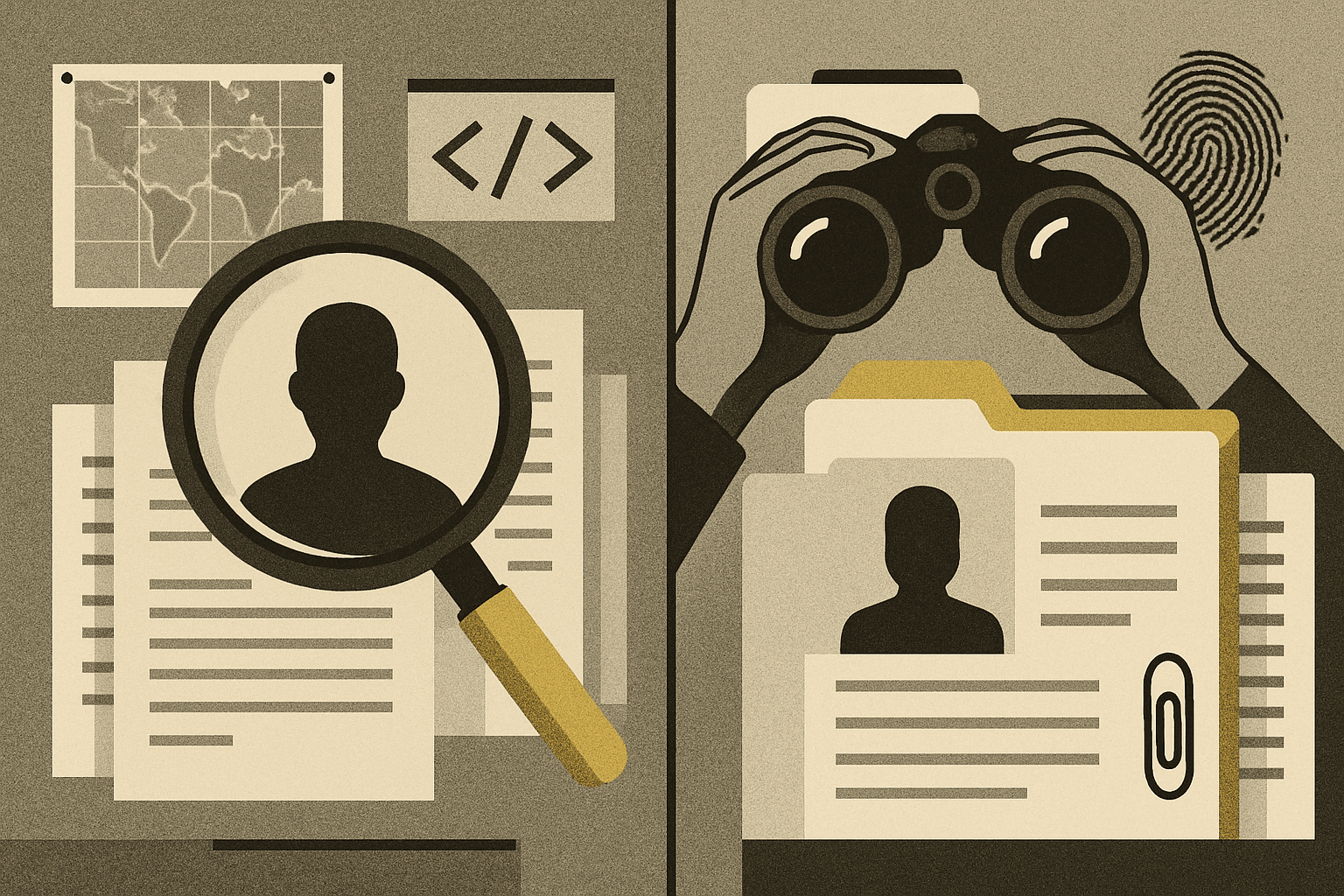
OSINT and background checks are not interchangeable due-diligence tools. A background check queries licensed, consent-gated databases for structured data points. Open-source intelligence is analyst-driven, iterative, and draws from the full breadth of publicly accessible sources, producing intelligence that formal database checks are structurally incapable of surfacing.
Defining the Two Disciplines: What Each Method Actually Does
Open-source intelligence predates the internet by decades, signals analysts and journalists built tradecraft from public records long before digital databases existed. Traditional background checks, formalised in employment law through the 1970s, occupy a different lineage entirely. Understanding each method's origins clarifies precisely what each can and cannot deliver to a Canadian law firm today.
What is a traditional background check and what data sources does it draw from?
Understand what a traditional background check includes and you quickly see it is a structured query of credentialed, gated databases. Providers pull criminal records from RCMP and provincial courts, credit checks from Canada's 2 major credit bureaus, Equifax and TransUnion, alongside employment and education verification. In Canada, this practice is governed by PIPEDA, enacted in 2001. Most commercial providers aggregate data from a finite, licensed set of sources, and consent from the subject is generally required in employment contexts.
What is OSINT and how does it differ from a formal database search?
Source intelligence OSINT is the lawful collection, processing, and analysis of information drawn from publicly accessible sources, social media platforms, corporate registries, court records, news archives, domain registrations, and leaked datasets. The NCSC defines open-source intelligence as information that is publicly available and does not require covert means to obtain. Unlike a database search, OSINT is analyst-driven, iterative, and not confined to licensed data silos. Analysts follow leads across multiple source types, building an intelligence product shaped by judgment as much as by data. For additional analytical methodology context, the Digital Hound blog is a useful reference resource.
Where the two approaches overlap, and where they diverge completely
Both methods may surface court records, public corporate filings, and adverse media. The divergence, however, is structural. Background checks produce a fixed-scope, consent-dependent report typically drawing from 3 to 5 discrete database categories. OSINT produces an intelligence product shaped by analyst judgment and the subject's digital footprint. Crucially, OSINT can map third-party networks surrounding a subject, whereas a background check is inherently subject-centric. Neither method is superior in the abstract, purpose governs tool selection entirely. See also: structured training path for OSINT mastery.
Core Structural Differences Between OSINT and Background Checks
Treating OSINT and a background check as interchangeable is a due-diligence error that Canadian law firms cannot afford. They differ in regulatory footing, data freshness, subject scope, and who is legally permitted to run them. Conflating the two methods in client onboarding or litigation support exposes the firm to both evidentiary and compliance risk.
For an authoritative examination of the overlap between OSINT and background checks, practitioners should consult specialist intelligence literature alongside legal guidance.
| Dimension | Background Check | OSINT Investigation |
|---|---|---|
| Regulatory basis | PIPEDA (2001), provincial CRA acts, Quebec Law 25 (2023) | PIPEDA purpose limitation, Charter s.8 (law-enforcement contexts) |
| Data currency | Point-in-time snapshot, typically 30–90 days old at delivery | Dynamic; refreshable continuously in real time |
| Subject scope | Individual-subject only | Individuals, entities, networks, IP addresses, vessels |
| Consent requirement | Written consent required (employment context) | Generally not required for publicly accessible data |
| Output format | Structured report with fixed data fields | Analyst-produced intelligence product, variable format |
| Typical turnaround | 1–5 business days | Days to weeks depending on scope and complexity |
Regulatory frameworks: FCRA-equivalent and PIPEDA constraints on background checks vs. open-source collection
Background checks require explicit written consent under PIPEDA for employment contexts. The U.S. Fair Credit Reporting Act (FCRA), codified in 1970, established a permissible-purpose doctrine that Canada mirrors through PIPEDA's purpose-limitation principle rather than through direct statute. Quebec Law 25, effective September 2023, imposes the most stringent provincial data governance framework in the country. FINTRAC's identity-verification requirements under PCMLTFA add an additional compliance layer for law firms onboarding clients, making regulatory alignment between investigative method and intended use essential.
Data currency and depth: static snapshots versus dynamic, real-time intelligence
A background check produces a point-in-time report, often reflecting analyzing publicly available data that is already 30 to 90 days old at delivery. OSINT, by contrast, is iterative and can be refreshed continuously. A subject's damaging adverse media published last week simply would not appear in a formal check ordered last month. For law firms managing evolving risk relationships, that lag has material consequences.
Scope of subject coverage: individuals, entities, and networks
Background checks are structurally individual-subject tools. Human intelligence tradecraft has long recognised that risk rarely exists in isolation, and OSINT reflects this: it can be applied to individuals, corporations, beneficial ownership chains, vessels, IP addresses, and interconnected social networks simultaneously. A single OSINT engagement can map a network of 10 or more related entities, which is critical for counterparty due diligence, judgment enforcement, and asset search operations, use cases where a conventional background report simply reaches its ceiling.
Who is authorised to run each type of investigation?
Background checks in employment contexts must be run by or through an authorised consumer reporting agency under applicable provincial CRA legislation. OSINT, by contrast, can be conducted by licensed private investigators, in-house intelligence analysts, or specialist OSINT firms. Canadian provinces including BC, Ontario, and Alberta, at minimum 3 major jurisdictions, require PI licensing for private investigations. Law firms instructing an OSINT provider should confirm that the provider holds appropriate provincial licensing. Importantly, law-firm privilege can attach to OSINT work product when it is properly instructed through legal counsel, offering a meaningful protective layer. See also: using OSINT effectively in litigation matters.
What Information Can OSINT Reveal That a Background Check Cannot?
What happens when a prospective client passes every standard background check, clean criminal history, verified employment, no adverse credit, yet within six months the firm is named in a regulatory complaint arising from that relationship? This scenario is not hypothetical. It reflects the structural gap between what formal database checks measure and what open-source intelligence can surface.
Behavioural signals and reputational indicators buried in public digital footprints
Public posts across social media platforms, forum participation, LinkedIn activity, and comment histories can reveal undisclosed affiliations, ideological positions, litigation history references, or financial distress signals. This is not character assessment, it is pattern recognition against documented public statements. Searches spanning 5 or more major networks can be conducted within a single analytical engagement. The distinction matters: an osint investigator documents observable, sourced public behaviour, not subjective inference about personality.
Corporate network mapping, beneficial ownership, and undisclosed affiliations
OSINT can cross-reference corporate registries across multiple jurisdictions, land title registries, court indices, and leaked incorporation data, including the Panama Papers and Pandora Papers. Canada's beneficial ownership registry under CBCA amendments effective 2023 still carries coverage gaps that OSINT can partially bridge through offshore name-matching. Property records in multiple provinces, combined with corporate filing cross-references, can surface nominee structures and undisclosed affiliations that no single domestic database would catch. For a full description of investigative services in this area, see Digital Hound's investigative practice. Background reports produced through these combined methods are markedly more comprehensive than their database-only counterparts.
Adverse media, sanctions exposure, and cross-jurisdictional risk flags
Adverse media screening processes cover news archives, court reporting, regulatory decisions, and enforcement actions across multiple languages and jurisdictions. Comprehensive sanctions screening should include 4 named lists: the OFAC SDN list, the UN Consolidated list, the OSFI Regulated Entities list, and FINTRAC advisories. A standard commercial background check typically screens only 1 or 2 domestic criminal databases. OSINT adverse media coverage can span dozens of jurisdictions simultaneously, which is operationally decisive when a counterparty has structurally obscured its risk profile across borders.
Does OSINT surface information that is inadmissible or legally problematic to act on?
This is a critical nuance for the law-firm audience. Publicly accessible information is generally lawful to collect, but its use may be constrained by PIPEDA's purpose limitation, employment standards legislation, and human rights codes across all 13 Canadian jurisdictions. Information surfaced through OSINT cannot automatically be acted upon in employment decisions, protected characteristics visible on social media, for example, must not inform hiring outcomes. The operative distinction is between intelligence, which informs strategy, and evidence, which is used in proceedings. Law enforcement operates under Charter s.8 constraints that add further complexity in those contexts. Analysts must document source, collection date, and URL to preserve the integrity of any OSINT product.
How OSINT Enhances and Extends the Traditional Background Check Process
Think of a background check as a structured x-ray, it images specific, predefined structures with precision. OSINT is closer to a full-body MRI: analyst-directed, broader in scope, and capable of revealing soft-tissue risk that the x-ray was never designed to detect. For Canadian law firms, the two are most powerful when used in sequence.
Scenarios Where OSINT Adds Measurable Value Beyond a Background Check
- Politically exposed person (PEP) screening where political office and state-owned enterprise associations are not captured in domestic databases
- Beneficial ownership gaps in the CBCA registry requiring cross-jurisdictional corporate mapping
- Cross-border counterparty risk where sanctions exposure spans non-Canadian lists
- Litigation target address history tracing for judgment enforcement and service of process
- High-value real estate transactions requiring shadow-entity and nominee-structure analysis
- High-risk client onboarding under FINTRAC enhanced due diligence obligations
For a detailed analysis of where OSINT adds depth to a formal screening report, specialist intelligence providers offer practical methodology guidance.
Using open-source intelligence to validate and cross-reference formal database results
Formal database results, name, date of birth, employment history, can be validated against open-source data including LinkedIn profiles, electoral roll data, corporate filings, and court records. Mismatches flag potential identity fraud or subject misrepresentation before the firm has committed to a relationship. In practice, 3 independent open-source confirmations is a working standard for identity validation. This is corroboration, not duplication, it layers analyst judgment over structured data, catching errors the database alone cannot detect.
Identifying gaps and inconsistencies a background check report would miss
Credit history anomalies may surface through OSINT even where formal credit checks return clean results. Employment gaps, undisclosed directorships, shadow social media accounts, and prior aliases typically do not appear in a database-driven check but surface through open-source analysis. A subject with a 2-year gap in declared employment history but active LinkedIn posts during the same period is a concrete example. Gaps and inconsistencies are not conclusions of wrongdoing, they are intelligence leads requiring further analysis. See the Digital Hound blog for related analytical methodology content on structuring these leads for legal review.
How does OSINT improve due diligence for high-risk client onboarding?
FINTRAC requires enhanced due diligence for 3 categories: politically exposed persons (PEPs), heads of international organisations (HIOs), and high-risk business relationships. A 2023 update to FINTRAC guidance reinforced these obligations for legal professionals. OSINT maps PEP indicators, political office, state-owned enterprise associations, family connections, that may not appear in a standard identity-verification package. Cross-jurisdiction adverse media and sanctions screening adds a real-time layer that static identity documents cannot provide, making OSINT an operationally necessary component of compliant onboarding at the elevated risk tier.
Tools and Methodologies Used in a Professional OSINT Investigation
As of 2024, there are more than 500 documented open-source intelligence tools catalogued in the OSINT framework, spanning social media platforms, domain analysis, dark web monitoring, and geospatial intelligence. For a law-firm audience, tool names matter less than understanding which methodological categories apply to legal-grade investigations and which carry jurisdiction-specific legal constraints.
Core OSINT platforms and their application to subject profiling
Maltego provides graph-based link analysis suited to network mapping; Palantir Gotham serves enterprise-scale investigations; Recorded Future delivers threat intelligence with historical pattern analysis. Free-tier tools such as SpiderFoot complement these platforms for targeted queries. Across these 3 platform categories, commercial enterprise, mid-tier, and open-source, platform choice must align with terms-of-service compliance and data-handling obligations under PIPEDA. A search engine query is the most rudimentary OSINT act; enterprise platforms are the professional end of the same spectrum.
Social media intelligence (SOCMINT) as a structured sub-discipline
SOCMINT is a recognised analytical sub-discipline distinct from casual social media searching. It involves systematic collection, archival, and analysis of publicly accessible content across platforms including LinkedIn, X (formerly Twitter), Facebook, Instagram, TikTok, and regional equivalents, a minimum of 6 named platforms. Social links between subjects and third parties, surfaced through structured SOCMINT methodology, can reveal undisclosed relationships that no database would capture. Critically, covert profile creation to access private content is unlawful in most Canadian contexts. Passive, overt collection of public content remains the governing principle for legally defensible work product.
Dark web monitoring and leaked-data review: scope and legal boundaries
Dark web monitoring involves scanning Tor-accessible forums, paste sites, and marketplaces for subject-related data including credentials, corporate documents, and PII. Lawful passive monitoring is permissible; active interaction, purchasing of data, or accessing restricted systems is not. Canadian Criminal Code s.342.1, unauthorised use of a computer, is the primary statutory constraint. Government guidance on lawful open-source collection addresses the boundary between passive monitoring and active system access. An email protected subject, for example, may have credentials appearing in a leaked dataset discoverable through passive dark web monitoring without any unlawful system interaction. Integrating OSINT into background investigation workflows requires that analysts document the method used to locate leaked data, not merely the data itself, to maintain evidentiary and ethical integrity.
Key Takeaways
- OSINT and background checks serve different structural purposes: background checks produce consent-based, database-driven reports; OSINT produces analyst-directed intelligence products drawn from publicly accessible sources.
- Regulatory compliance is method-specific: PIPEDA and provincial CRA legislation govern background checks; OSINT is subject to purpose limitation and, in law-enforcement contexts, Charter s.8 scrutiny.
- OSINT fills gaps background checks structurally cannot: beneficial ownership mapping, adverse media across dozens of jurisdictions, sanctions screening against 4 international lists, and network analysis of related entities.
- The two methods are most powerful in sequence: use the background check to establish structured baseline data, then layer OSINT to validate, extend, and flag inconsistencies a database-only approach misses.
- Provider qualification matters: Canadian law firms should confirm that any OSINT provider holds applicable provincial PI licensing, and should instruct OSINT work through counsel to preserve the possibility of privilege attachment.
FAQ
What is the main difference between OSINT and a background check?
A background check is a structured query of licensed, gated databases, criminal records, credit bureaus, employment verification, requiring subject consent in most Canadian contexts. OSINT is the lawful collection and analysis of publicly accessible information, analyst-driven and not limited to predefined data categories. The key distinction is scope: a background check is fixed and subject-centric; OSINT is iterative, network-aware, and capable of crossing jurisdictions.
Is OSINT legal for Canadian law firms to use?
Yes, collecting and analysing publicly accessible information is generally lawful. The constraints are purpose limitation under PIPEDA, provincial privacy legislation including Quebec Law 25 (2023), and Charter s.8 in law-enforcement contexts. Firms should ensure the OSINT provider holds provincial PI licensing where applicable, and should consider instructing the work through legal counsel to preserve work-product privilege.
Can OSINT replace a formal background check entirely?
No. OSINT and background checks occupy different regulatory and methodological categories. Background checks provide structured, consent-based verification of identity, criminal history, and credit data through licensed channels. OSINT provides intelligence depth, network mapping, and real-time adverse media coverage. For high-risk client onboarding, litigation support, or enhanced due diligence under FINTRAC obligations, both methods used in sequence deliver materially better outcomes than either method alone.
What OSINT tools do professional investigators use?
Professional OSINT investigators use a range of tools depending on scope:
- Graph-based link analysis: Maltego
- Enterprise intelligence: Palantir Gotham, Recorded Future
- Automated reconnaissance: SpiderFoot
- SOCMINT collection: platform-specific archival tools for LinkedIn, X, Facebook, and others
- The OSINT Framework catalogues 500+ tools as of 2024
Tool selection must align with terms-of-service compliance, data-handling obligations, and the evidentiary standards required by the instructing law firm.
How does OSINT support FINTRAC compliance for law firms?
FINTRAC requires enhanced due diligence for PEPs, HIOs, and high-risk business sectors. OSINT maps political office connections, state-owned enterprise associations, and adverse media that identity documents alone cannot surface. Sanctions screening through OSINT covers the OFAC SDN list, UN Consolidated list, OSFI Regulated Entities list, and FINTRAC advisories, four lists that standard commercial background checks do not routinely include. This makes OSINT operationally necessary for compliant high-risk onboarding.